
Why a BVI Incubator Fund Is the Smartest Way to Launch in 2026
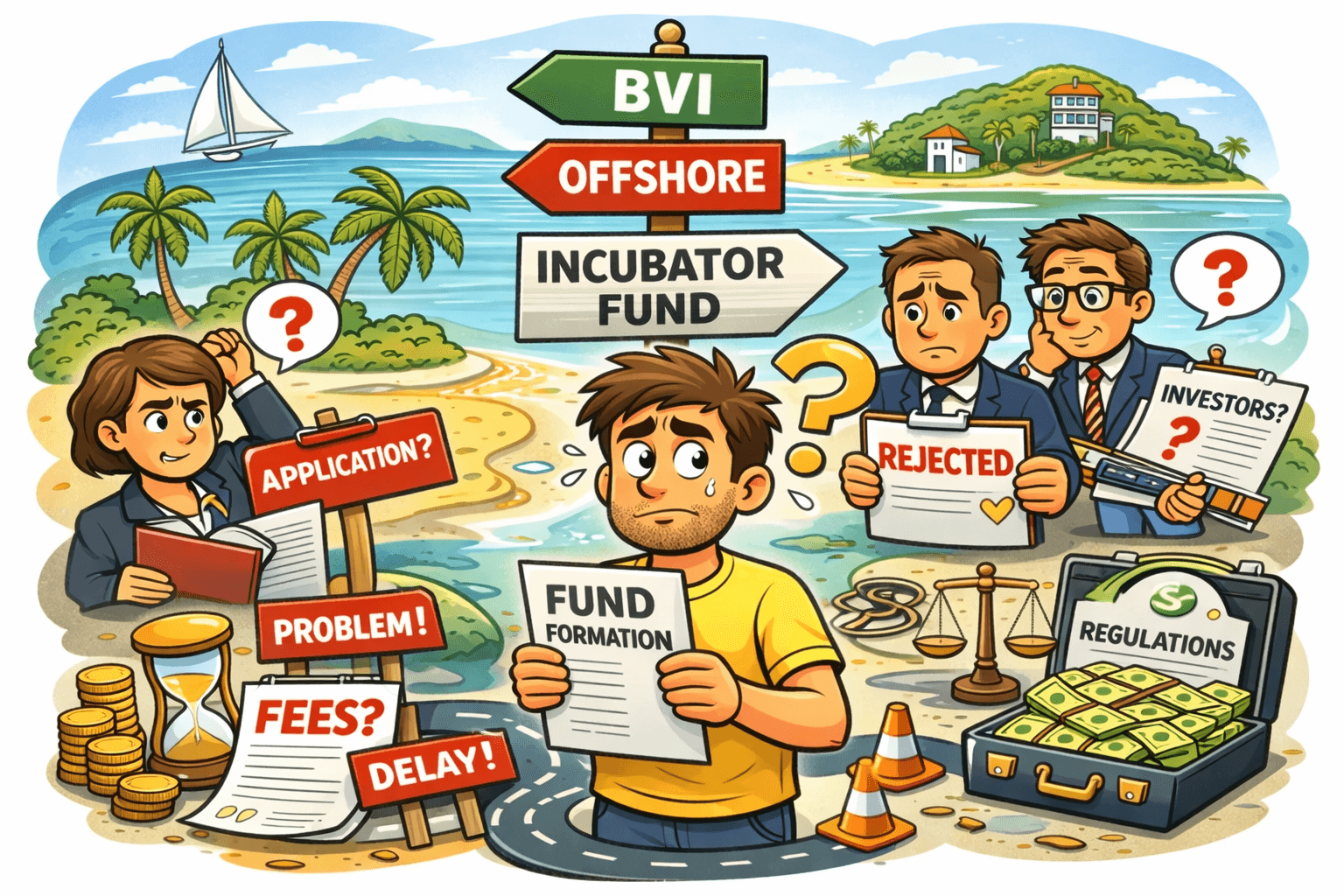
You've been trading crypto for three years. You're up. Your friends know you're up. Their friends know you're up. And now someone — maybe several someones — has said the magic words:
"Can I give you money to invest?"
Congratulations. You are now standing at the edge of the fund management industry, looking down.
The good news: there has never been a better time to take the leap.
The bad news: most people who try to set up a crypto fund end up buried in legal fees, compliance requirements, and structural decisions they don't fully understand — before they've made a single trade.
This post is about a better way to do it.
The problem: fund setup was never designed for people like you
Traditional fund formation was built for institutional managers with $100 million in commitments, a legal team on retainer, and a Rolodex of service providers. It assumes you already have auditors, administrators, custodians, compliance officers, and a prime brokerage relationship.
The cost? Easily $50,000–$150,000 before you've deployed a dollar. In Cayman, more like $80,000–$200,000 when you factor in ongoing admin. And the timeline? Months.
For an emerging crypto manager with a promising strategy, a handful of committed investors, and a few million dollars in expected AUM, this is absurd. You're not trying to launch BlackRock. You're trying to prove you can do this professionally, build a track record, and grow from there.
The industry has historically had no good answer for that.
Until the BVI figured one out.
Enter the BVI Incubator Fund
In 2015, the British Virgin Islands introduced the Incubator Fund — a streamlined, regulated investment fund designed specifically for emerging managers. It's sometimes called the "20-20-20 fund" because of its three defining limits:
• *20 investors* maximum
• *$20,000* minimum investment per investor
• *$20 million* net asset value cap
The incubator fund is recognised and regulated by the BVI Financial Services Commission (FSC), but with dramatically reduced requirements compared to traditional fund structures. Here's what you don't need:
• No mandatory licensed investment manager
• No mandatory custodian
• No mandatory administrator
• No mandatory auditor
• No offering memorandum requirement (investor disclosures can be handled via a term sheet)
What you do need: a BVI Business Company, at least two directors (one must be an individual), a BVI-authorised representative, and compliance with BVI anti-money laundering rules (including an MLRO function).
The result is a real, regulated fund vehicle that you can launch quickly, affordably, and without the overhead that kills most first-time fund managers before they start.
Why this matters for crypto — specifically
The BVI incubator fund wasn't designed with crypto in mind. It predates the crypto fund boom by several years. But it has turned out to be an almost perfect fit for crypto fund managers, for a few reasons worth understanding:
No additional crypto licensing. Unlike jurisdictions that have bolted on separate virtual asset licensing regimes (often adding cost, complexity, and months of waiting), the BVI treats crypto as just another asset class inside the fund. You don't need a separate licence to hold Bitcoin, Ethereum, or any other digital asset. The fund structure works the same way whether you're trading tokens or Treasury bills.
Custody flexibility. Because there is no mandatory custodian requirement, you have the flexibility to choose the custody arrangement that fits your strategy — whether that's an institutional custodian like Coinbase Prime or Anchorage, a multi-sig setup, or a combination. You're not forced into an arrangement that doesn't suit your asset mix.
Speed. FSC recognition can happen in a matter of days, not months. If your documents are in order, you can be operational in weeks.
Cost. Setup costs for a BVI incubator fund typically run in the range of $15,000–$25,000 all-in, depending on the provider. Compare that to six figures in Cayman or Luxembourg.
Track record building. The two-year initial term (extendable by one year) is explicitly designed as a proving ground. Build your track record, demonstrate your strategy, and then convert to a larger fund structure — Approved, Private, or Professional — when the numbers justify it.
For a crypto-native manager, this is exactly the right shape: lean enough to start, credible enough to attract serious investors, and flexible enough to accommodate the realities of managing digital assets.
Why now? Because the window is wide open
If you've been thinking about launching a crypto fund, the timing in 2026 is unusually good. Not because of hype — because of structure.
Institutional capital is arriving. According to multiple industry surveys, over 75% of institutional investors plan to expand their digital asset exposure in 2026. Many are targeting allocations of 5% or more of AUM. Spot Bitcoin ETFs have brought in over $57 billion in net inflows since 2024. The institutional pipeline is real, and it's growing.
Regulatory clarity is improving. The US passed the GENIUS Act in 2025, establishing federal stablecoin standards. The CLARITY Act is working through Congress to address market structure. The EU's MiCA framework is operational. Singapore, the UAE, and the UK all have clearer regulatory positions than they did two years ago. The era of "regulation by enforcement" is giving way to actual rule-setting.
The market has matured. Custody infrastructure is institutional-grade. Valuation methodologies are more standardised. Compliance tooling — wallet screening, transaction monitoring, Travel Rule compliance — is now table stakes. The operational stack for running a crypto fund professionally exists in a way it simply didn't in 2021.
Investors are looking for managed exposure. Not everyone wants to self-custody. Not everyone wants to pick tokens. The appetite for professionally managed crypto vehicles — especially from family offices, HNW individuals, and smaller institutions — is growing fast. But these investors want a real fund, with a real structure, domiciled in a recognised jurisdiction. A WhatsApp group and a shared wallet doesn't cut it anymore.
All of which means: if you have a strategy and a small group of committed investors, the infrastructure to do this properly now exists — and the BVI incubator fund is the most efficient on-ramp.
What "crypto fund in a box" actually looks like
At Entity Engine, we set up BVI incubator funds for a fixed fee of $15,000. Here's what that covers:
The entity. A BVI Business Company, properly incorporated, with articles of association tailored for use as an open-ended investment fund.
The fund licence. Application to the BVI FSC for recognition as an incubator fund, including preparation of all required documentation and filings.
Constitutional documents. Memorandum and Articles of Association drafted and settled for fund use.
Investor documentation. Term sheet or offering document setting out the fund terms, investor warnings, fee structure, and subscription process.
Authorised representative. Appointment of a licensed BVI authorised representative, as required by the regulations.
Compliance foundations. Guidance on AML/KYC obligations and MLRO function setup.
In other words: everything you need to go from "I want to launch a fund" to "I have a regulated fund vehicle ready to accept capital" — without the usual six-figure legal bill, the three-month timeline, or the existential confusion about what you actually need.
The graduation path: incubator is the beginning, not the ceiling
One of the smartest features of the BVI fund regime is that the incubator fund isn't a dead end. It's a starting point with a built-in progression:
Incubator Fund → up to $20M, 20 investors, 2-year term (+ 1-year extension)
Approved Fund → up to $100M, 20 investors, no time limit, requires a fund administrator
Professional Fund → $100,000 minimum investment, no NAV cap, broader service provider requirements
Private Fund → up to 50 investors, full service provider requirements
If your strategy works and your fund grows, you convert — not start over. The BVI FSC has established procedures for conversion between fund types, and the process is designed to be smooth rather than punitive.
This means you can start small, stay compliant, and scale into a more sophisticated structure as your AUM and investor base justify it. You're not locked in. You're building up.
What about the 20 investor cap? It's less limiting than you think
Twenty investors sounds tight. And for some fund managers, it is a real constraint — especially if you have a broad network of smaller investors who want in.
But there's a well-established workaround: use an SPV (Special Purpose Vehicle) as a feeder.
Here's how it works. Instead of each individual investor subscribing directly to the incubator fund, you set up a separate entity — typically another BVI Business Company — and your investors subscribe to that entity. The SPV then invests into the incubator fund as a single investor. One slot used, multiple investors aggregated.
From the fund's perspective, the SPV counts as one investor against the 20-investor cap. From the investors' perspective, they each hold an interest in the SPV, which gives them economic exposure to the fund.
This means:
• If you have 30 investors, you could route some through an SPV and stay well within the cap
• You can use multiple feeder SPVs if needed — one for US investors, one for non-US, one for a particular group or community
• Each SPV is a corporate entity with its own ownership structure, so it can accommodate a large number of underlying investors without affecting the fund's investor count
• For crypto-native managers, this also opens up the possibility of tokenising the shares of the feeder SPV — giving a wider pool of investors access to the fund through a token-based structure at the feeder level, while the fund itself remains a conventional regulated vehicle
The SPV approach is not a loophole. It's a standard structuring technique used across the fund industry, and the BVI FSC is well familiar with it. The key is that the SPV itself is properly constituted, with its own KYC/AML compliance, and that the arrangement is documented correctly.
Entity Engine can set up feeder SPVs alongside your incubator fund. If you know you'll have more than 20 investors — or if you want to segment your investor base by geography, type, or access mechanism — this is worth building in from the start rather than retrofitting later.
Who should be thinking about this?
The BVI incubator fund is a strong fit if you are:
• A crypto-native trader or portfolio manager with a defined strategy and a small group of investors ready to commit capital
• A DeFi or on-chain strategist who wants to formalise what is currently an informal arrangement
• A family office or investment group looking for a low-cost, regulated vehicle to pool capital for digital asset exposure
• An emerging manager who needs a track record inside a recognised fund structure before approaching institutional allocators
• Anyone currently running informal capital management via group chats, shared wallets, or handshake agreements who knows this needs to be professionalised
If any of those sound familiar, the incubator fund is probably the right shape for your next step.
The cost of waiting
Here's the thing founders and emerging managers often get wrong: they wait for the "right time" to set up a fund, and in the meantime they either trade informally (which creates legal exposure), miss the market timing (which costs returns), or spend months over-researching structures that are more complex than what they actually need.
The incubator fund exists specifically so you don't have to do that.
It's a low-cost, low-overhead, time-limited proving ground inside a regulated framework. It's designed for exactly this stage. And at $20,000 for the full setup through Entity Engine, the barrier to doing this properly is lower than most people assume.
The market isn't waiting. The capital is moving. The infrastructure is ready.
The only question is whether your fund structure is.
Entity Engine sets up BVI incubator funds for a fixed fee of $20,000. If you're ready to launch, or just want to understand what the process looks like, [get in touch](https://www.entityengine.io/#contact-us).
This post is for informational purposes only and does not constitute legal, tax, or investment advice. Entity Engine is not a law firm. Fund formation involves regulated activities performed by licensed third-party partners in the BVI.