
The Future of Corporate Services Is API-Driven — And It's Already Here
For decades, the corporate services industry has operated the same way: emails back and forth, PDFs sent between time zones, local agents in every jurisdiction, and manual processes holding everything together with digital duct tape. It has been slow, fragmented, and expensive — a model built for a world that no longer exists. Today, founders, intermediaries, advisors, and platforms are demanding something fundamentally different: speed, transparency, and the ability to operate globally without friction. The shift is already underway, and the firms that recognise it early will define the next era of professional services.
What Does API-Driven Corporate Services Actually Mean?
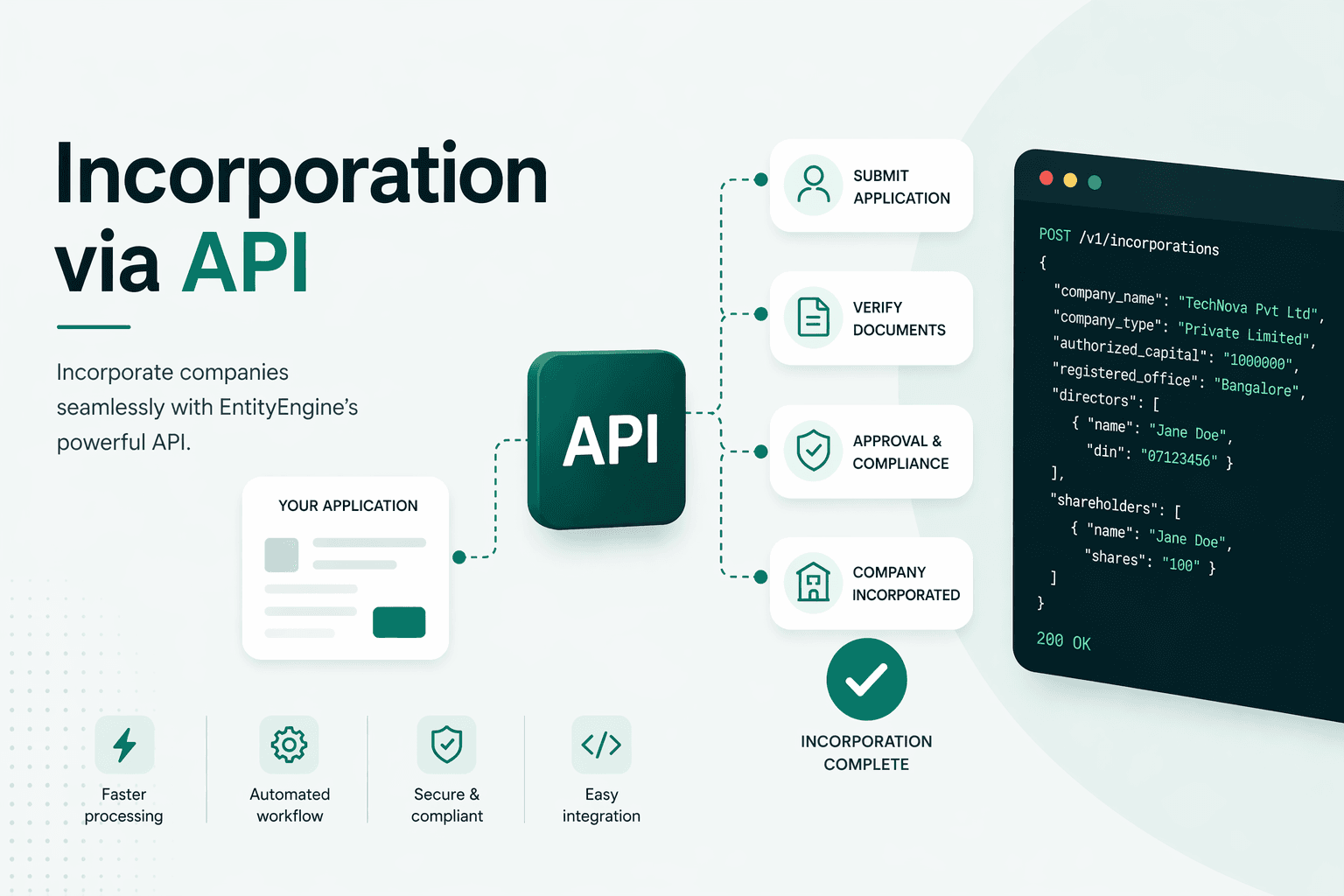
The phrase "API-driven" is used broadly in technology, but in the context of corporate services it carries specific, practical weight. An API-first approach means that every action — incorporating a company, updating beneficial ownership records, triggering compliance workflows, delivering signed documents — can be executed programmatically, without manual intervention. Rather than relying on a human to open an email and forward a form, the entire process becomes a structured data exchange between systems.
For intermediaries and platforms operating at any meaningful volume, this is not a nice-to-have. It is the difference between a business that scales and one that hits a ceiling. EntityEngine's API framework is designed precisely around this principle — enabling partners to build entity formation and management directly into their own workflows and client-facing systems.
EntityEngine: The Infrastructure Layer for Modern Intermediaries
EntityEngine is a digital-first corporate services platform that allows businesses, advisors, and intermediaries to form, manage, and scale corporate entities across multiple jurisdictions — all through a single, unified interface. But describing it simply as a formation tool undersells what is actually being built.
At its core, EntityEngine is an infrastructure layer. The platform has been architected from the ground up with APIs and webhooks central to every function. Partners can:
Programmatically incorporate companies across supported jurisdictions without manual back-and-forth
Automate entity lifecycle management, from initial formation through to compliance renewals and structural changes
Sync real-time updates directly into internal CRMs, practice management systems, or client portals
Build fully integrated client onboarding journeys that feel native to their own product
The result is a corporate services operation that is structured, repeatable, and genuinely scalable — regardless of the volume of clients or the number of jurisdictions involved.
White-Label: Expanding What Intermediaries Can Offer
One of the most significant commercial opportunities within EntityEngine's model is its white-label capability. For intermediaries — whether law firms, accounting practices, fiduciary services providers, or fintech platforms — the ability to offer entity management under their own brand is transformative.
Rather than referring clients elsewhere, losing deals to competitors with broader infrastructure, or building costly in-house systems, intermediaries can deploy a fully branded entity management platform powered by EntityEngine. This means:
A seamless, professional client onboarding experience under your own name
Multi-jurisdictional structuring solutions delivered at scale
No need to manage individual provider relationships or navigate jurisdictional complexity independently
A product offering that competes with the largest corporate services providers in the market
This model is particularly compelling for firms that have historically been limited by geography or operational capacity. The white-label layer removes those constraints entirely.
Multi-Jurisdiction Capability: Removing the Biggest Growth Barrier
Jurisdictional limitation has long been one of the most frustrating constraints for intermediaries looking to grow. Serving a client who needs a BVI limited company alongside a Singapore holding structure and a UAE operating entity has traditionally meant managing three separate provider relationships, three sets of timelines, and three different communication channels — all while maintaining a coherent client experience.
EntityEngine removes that friction. The platform covers a broad and growing range of jurisdictions, from offshore structures such as the Cayman Islands Exempted Limited Company and the Seychelles IBC, to onshore and mid-shore options including Singapore Pte Ltd, Irish Limited companies, and US structures such as the Delaware LLC. Explore the full range of available structures on the EntityEngine jurisdictions page.
For intermediaries, this multi-jurisdiction capability opens up several meaningful commercial opportunities:
Diversify revenue streams by serving clients with more complex, cross-border structuring needs
Expand service offerings without expanding headcount or operational overhead
Attract and retain international clients who require global solutions from a single trusted provider
Move up the value chain by becoming a strategic partner rather than a transactional service provider
Why the Timing Matters
The shift toward digital-first corporate services is not a distant trend — it is happening now, driven by client expectations that have been permanently reset by their experiences in other industries. The same founders and operators who manage their banking through an app, sign contracts electronically, and onboard to new platforms in minutes are not willing to accept a six-week company formation process that requires notarised documents sent by courier.
Speed, transparency, and digital-first delivery are no longer differentiators. They are baseline expectations. Firms that can meet those expectations will win the next generation of clients. Those that cannot will find themselves increasingly marginalised, regardless of their existing relationships or reputation.
It is worth understanding where EntityEngine fits within this broader shift. For advisors who want the full picture, the story behind why EntityEngine was built speaks directly to the problem this platform was designed to solve.
Who EntityEngine Is Built For
EntityEngine's platform and partner model is designed for a specific type of operator: one who is serious about scaling, values infrastructure over improvisation, and recognises that the quality of their back-end determines the quality of their client experience.
The platform is particularly well-suited to:
Intermediaries and corporate service providers looking to automate operations and expand jurisdictional reach
Legal and accounting firms that want to offer entity management under their own brand without building infrastructure
Fintech and wealth platforms that need programmatic entity formation as part of a broader client journey
Web3 teams and founders requiring fast, compliant structures across multiple jurisdictions — explore the web3 use cases for more detail
Family offices and operators managing multi-entity structures across global markets
If you are unsure which structure best fits your needs or those of your clients, the EntityEngine use cases section provides a practical framework for matching entity types to real-world requirements.
The Infrastructure Advantage
There is a meaningful difference between a platform that digitises existing corporate services processes and one that rebuilds them from first principles for a digital-first world. The former is a marginal improvement. The latter is a structural advantage.
EntityEngine falls firmly in the second category. By building API connectivity, webhook-driven automation, white-label deployment, and multi-jurisdiction coverage into the platform's core architecture, it gives intermediaries and platforms capabilities that would otherwise require years of development and millions in investment to replicate independently.
The corporate services industry is in transition. The firms that move now — that invest in the right infrastructure, align with the right platforms, and deliver the digital-first experiences their clients expect — will be the ones that define what professional services looks like in the next decade.
Get Involved
The window to build a genuine competitive advantage through infrastructure is open, but it will not stay open indefinitely. Whether you are looking to expand into new jurisdictions, offer entity services under your own brand, or automate and scale your operations, this is the right moment to act.
EntityEngine is actively working with intermediaries, advisors, and platforms who are ready to operate differently. If that sounds relevant to where your firm is headed, visit the EntityEngine platform to learn more — or reach out directly to start a conversation about what a partnership could look like for your business.