
EU MiCA Explained: What Web3 Projects Need to Know
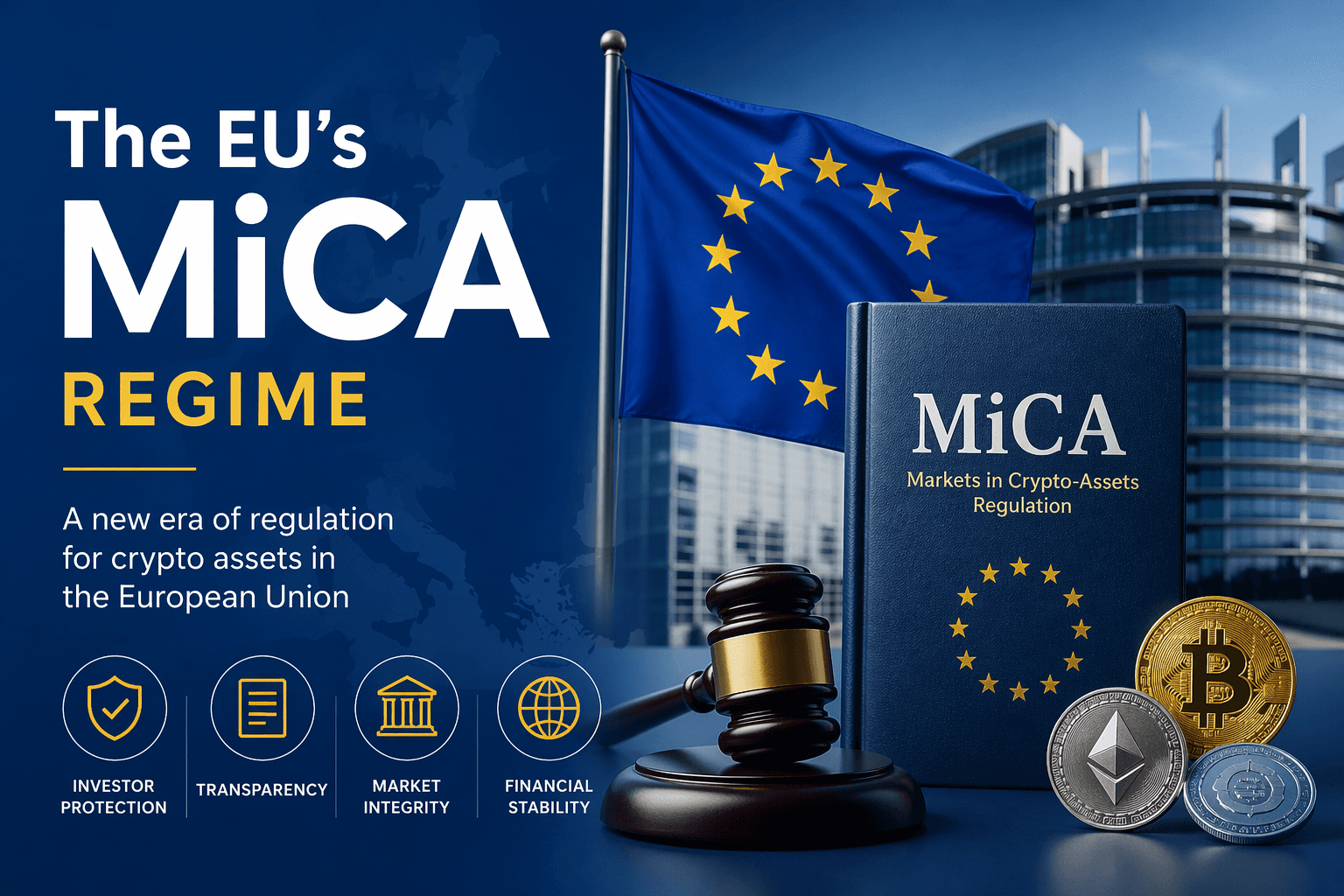
For years, crypto and blockchain founders operated in a regulatory grey zone across the European Union; uncertain whether their token was a security, a utility, or something the law hadn't yet named. That ambiguity is ending. The EU's Markets in Crypto-Assets (MiCA) regulation is now in force, and it represents the most comprehensive crypto regulatory framework any major jurisdiction has produced to date. Whether you're launching a stablecoin, running a crypto exchange, or building a DeFi protocol with EU users, MiCA will affect you. This guide provides a clear, authoritative overview of what MiCA is, who it applies to, and what your team should be doing about it.
What Is MiCA?
The Markets in Crypto-Assets Regulation (Regulation (EU) 2023/1114) is a landmark piece of European Union legislation designed to create a harmonised legal framework for crypto-assets and the businesses that deal with them. It was published in the Official Journal of the EU in June 2023 and has been phasing into full applicability since then, with stablecoin provisions applying from June 2024 and broader requirements from December 2024.
Before MiCA, each EU member state applied its own patchwork of national rules, or no specific rules at all, to crypto businesses. MiCA replaces that fragmentation with a single rulebook valid across all 27 EU member states. Once authorised in one member state, a crypto-asset service provider (CASP) can passport those services across the entire EU, much like a bank or investment firm.
What Does MiCA Cover?
MiCA draws a clear taxonomy of crypto-assets and regulates them accordingly. Understanding which category your product falls into is the first step toward compliance.
Asset-Referenced Tokens (ARTs): Tokens that maintain a stable value by referencing a basket of assets, currencies, or commodities. Issuers must obtain authorisation from their home member state's competent authority and hold adequate reserves.
E-Money Tokens (EMTs): Tokens pegged to a single fiat currency (e.g., a euro stablecoin). These are treated similarly to electronic money and require authorisation as an e-money institution or credit institution.
Other Crypto-Assets: A catch-all category covering utility tokens, governance tokens, and most other crypto-assets not classified as ARTs or EMTs. Issuers must publish a crypto-asset white paper and comply with disclosure obligations, though the requirements are lighter than for ARTs and EMTs.
Importantly, MiCA does not currently cover crypto-assets that qualify as financial instruments under MiFID II (which remain subject to existing securities law), nor does it provide a comprehensive framework for fully decentralised protocols where no identifiable issuer exists.
Who Are Crypto-Asset Service Providers (CASPs)?
Beyond token issuers, MiCA introduces a licensing regime for Crypto-Asset Service Providers, any business providing regulated crypto services to EU clients. These services include:
Custody and administration of crypto-assets on behalf of clients
Operating a trading platform for crypto-assets
Exchange of crypto-assets for fiat currency or other crypto-assets
Execution of orders on behalf of clients
Placing of crypto-assets
Reception and transmission of orders
Providing advice on crypto-assets
Portfolio management of crypto-assets
Providing transfer services for crypto-assets
CASPs must be authorised by a national competent authority in at least one EU member state before they can legally offer services within the EU. Entities already registered under national anti-money laundering frameworks were given a transitional period to obtain full CASP authorisation.
Key Obligations for Web3 Projects
The practical compliance burden under MiCA varies significantly depending on your business model, but several obligations are broadly applicable.
White Paper Requirements
Any person publicly offering a crypto-asset (other than an ART or EMT, which have their own prospectus-style requirements) must publish a crypto-asset white paper that includes detailed disclosures about the project, the token, the rights it confers, the technology, and the risks. The white paper must be notified to the relevant national authority before publication and is subject to civil liability if it contains misleading information.
Market Integrity Rules
MiCA introduces prohibitions on insider dealing, unlawful disclosure of inside information, and market manipulation, mirroring the market abuse framework that applies to traditional securities markets. Founders, employees, and advisers with access to material non-public information must tread carefully around token sales and trading activity.
Governance and Organisational Requirements
CASPs must meet minimum capital requirements, maintain fit-and-proper management, implement robust governance frameworks, hold client assets segregated from company assets, and maintain comprehensive complaint-handling procedures. Larger stablecoin issuers face additional prudential obligations and oversight by the European Banking Authority (EBA).
Consumer Protection
CASPs are required to act honestly, fairly, and in the best interests of their clients. Marketing communications must be fair, clear, and not misleading. Certain high-risk products require specific warnings. Influencer marketing and social media promotion of crypto-assets fall within the scope of these rules.
Implications for Token Issuers
If your web3 project involves issuing a token accessible to EU residents, MiCA likely applies to you, regardless of where your company is incorporated. The regulation takes a market-access approach: it's the EU nexus of your users, not the location of your servers or legal entity, that triggers its application.
This has significant structural implications. Many projects historically incorporated in offshore jurisdictions to achieve operational flexibility. Under MiCA, if you want to lawfully serve EU users, you may need either a direct CASP authorisation in an EU member state or a carefully structured arrangement that avoids bringing regulated activities within MiCA's scope. EU member states popular with web3 businesses include Ireland, the Netherlands, and Malta, each offering different tax, regulatory, and operational profiles. For example, a Dutch Besloten Vennootschap (BV) is a frequently used EU holding and operating structure, while a Malta Ltd benefits from Malta's established position as an early mover in crypto regulation within the EU.
Projects that do not wish to establish an EU entity face a stark choice: geofence EU users out of their product entirely, or risk operating unlawfully in the world's largest single market.
MiCA and DeFi: The Open Question
Fully decentralised protocols present MiCA's most significant conceptual challenge. The regulation explicitly notes that it does not apply to crypto-asset services provided in a fully decentralised manner without any intermediary. However, the vast majority of DeFi projects have some centralised element — a front-end, a team with admin keys, a foundation that exercises control — and regulators are expected to look through superficially decentralised structures to identify responsible parties.
The European Securities and Markets Authority (ESMA) and the EBA are expected to publish further guidance on how MiCA applies to DeFi over the coming years. Until that clarity arrives, DeFi teams with EU exposure should obtain qualified legal advice on whether their protocol has an identifiable issuer or CASP for MiCA purposes. Keeping across regulatory developments in the crypto space is essential for any team navigating this landscape.
Choosing the Right Jurisdiction and Structure
MiCA compliance does not mean every web3 project must become a fully regulated EU entity. Strategic corporate structuring, using EU entities for regulated activities and separate holding or IP structures elsewhere, remains a legitimate and widely used approach. The right structure depends on your business model, token type, user base, and growth plans.
For founders exploring their options, understanding the full range of available jurisdictions is critical. Entity Engine's web3 structuring solutions are designed specifically for crypto and blockchain teams navigating exactly these decisions, from selecting the right entity type to managing multi-jurisdictional compliance requirements. You can also use our token structure quiz to get an initial read on which entity and jurisdiction combination may suit your token issuance needs.
Projects that want EU market access without a full EU operating entity may find that jurisdictions with bilateral arrangements or recognised equivalence regimes offer interim pathways, though MiCA's third-country provisions are strict, and reliance on reverse solicitation (where EU clients proactively approach a non-EU firm) is explicitly narrowed under the regulation.
Conclusion
MiCA is not a threat to web3 innovation, it is the regulatory maturity the industry has long needed to attract institutional capital and mainstream adoption into European markets. For founders and operators who understand the framework, it creates opportunity: a clear licence to operate across 450 million consumers with a single authorisation. The teams that prepare early, structure thoughtfully, and engage with competent authorities proactively will be best placed to capture that opportunity. If you're ready to explore what your MiCA-compliant structure could look like, explore the full range of jurisdictions available through Entity Engine and start building with confidence.